
The Need for Safer, Sustainable Materials
Synthetic chemicals, such as artificial colorants, are used in everyday products, including foods, cosmetics, and other personal care products. Often, these synthetic chemicals are endocrine disruptors that can persist in the environment for many years, causing harm to our bodies and the planet. Therefore, the demand for safer, sustainable alternatives is urgent.
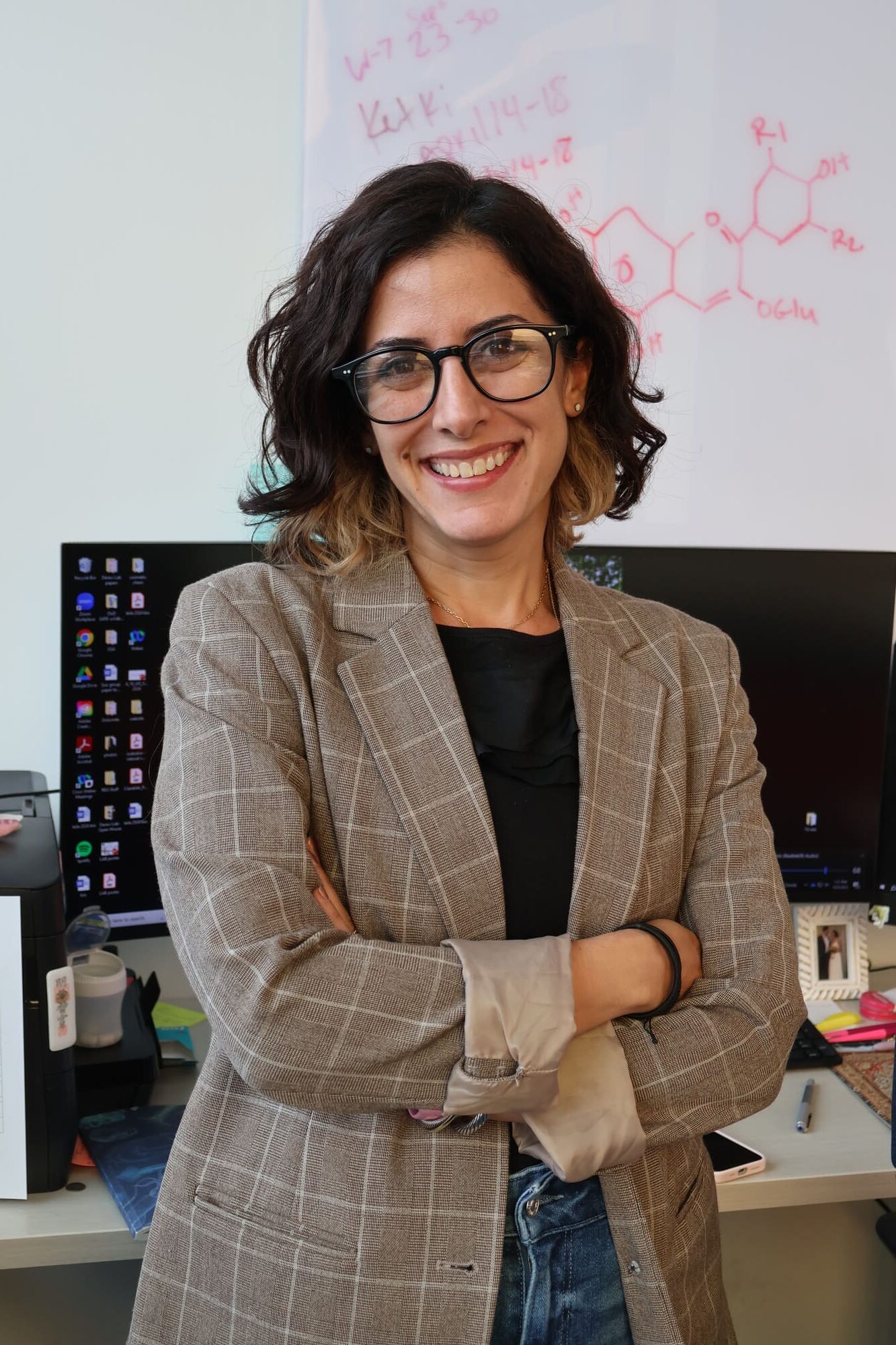
At Northeastern University, Associate Professor of Chemistry & Chemical Biology Leila Deravi is taking a cue from nature to meet that challenge. She and her team are designing bio-inspired materials that are effective and inherently safer for people and the planet.
Deravi, who holds a PhD in chemistry and leads Northeastern’s Bio-Inspired Material Design Laboratory, has long been fascinated by the mysteries of biology. Her early studies of cephalopods—squid, octopus, and cuttlefish—sparked a career-long curiosity to figure out how to emulate these naturally color-changing animals for consumer products.
“We want to understand how these animals’ color changes naturally in the ocean,” she says. “We look at what materials they use to do this, and what we can do in the lab to recreate these materials for consumer applications.”
Recreating Nature’s Chemistry for Safer Consumer Products
Deravi’s research centers on decoding how nature builds durable, multifunctional materials and on reproducing those mechanisms in the lab. Her lab studies natural pigments and proteins that generate vibrant color, as well as their secondary effects, such as antioxidant properties and natural UV protection. By translating those biological systems into engineered molecules and polymers, her team is developing safer alternatives for cosmetics, personal-care products, and food colorants.
“We use bio-inspired approaches that originate in nature,” Deravi explains. “Because they’re safe in nature, we believe these properties will also be safer for our applications.”
Beyond cosmetics and topical applications, artificial colorants and additives are also used in the food industry. They are also linked to toxicity, hormonal disruption, and environmental persistence. Deravi’s work aims to design natural replacements that maintain stability and performance without the harmful effects.
Her discoveries could usher in a new generation of sustainable pigments and bio-derived materials that enhance safety across multiple industries.
From Discovery to Industry Impact
After years of fundamental research to discover and understand natural proteins and pigments, her lab is now focused on translating these discoveries from the bench to the marketplace.
Seaspire Skincare has spun out from her lab to develop and market these nature-inspired colorants for personal-care applications. After eight years of foundational work identifying and characterizing squid-derived pigments, Deravi and her team are now pursuing commercialization opportunities through partnerships and spinouts to get their technology into the industry.
Her lab’s core technology has pending U.S. and European patent applications, covering methods for synthesizing and stabilizing natural pigment complexes.
Global Recognition for Innovation in Sustainable Chemistry
This year, Deravi and her team won second place in the MassCEC and FedTech ClimateTech Studio program, which helps researchers commercialize cleantech and climate-aligned technologies. By connecting innovators with mentors, investors, and market experts, the program also helped Deravi’s team refine its strategy for scaling and real-world application.
How CRI Helps Translate Research Into Real-World Impact
Northeastern’s Center for Research Innovation (CRI) has supported Deravi’s lab in navigating the path from discovery to market.
“CRI has been a phenomenal resource for us,” says Deravi. “Their leadership team has helped us create meaningful engagements with outside stakeholders who have informed our decisions in the lab and guided us on how to translate our technologies into real-world products that others can use in the industry.”
This type of early-stage support is critical for researchers seeking to move from academic discovery to commercial impact. By combining scientific innovation with CRI’s strategic guidance, Deravi’s work is poised to redefine what innovative, sustainable material design can look like.
Looking Ahead: Scaling Sustainable Innovation Through Partnerships
The team’s next priority is to scale production and forge partnerships with leaders in the cosmetics and food industries. Her goal is to establish a clear pipeline from laboratory innovation to consumer products, ensuring that sustainable materials are accessible and affordable on a global scale.
To achieve that vision, her team seeks collaboration with decision-makers in the personal-care, chemical, and food sectors who share her commitment to sustainability. “We’re building a bridge between fundamental discovery and commercial reality,” Deravi says. “The more we can connect with partners who value safer, more sustainable materials, the faster we can bring these innovations to market.”
By looking to nature’s own playbook, Deravi is creating materials that have the potential to be as safe as they are sophisticated, leading a new wave of green tech and sustainable innovation from Northeastern University. Learn more about her work on Northeastern Global News.