
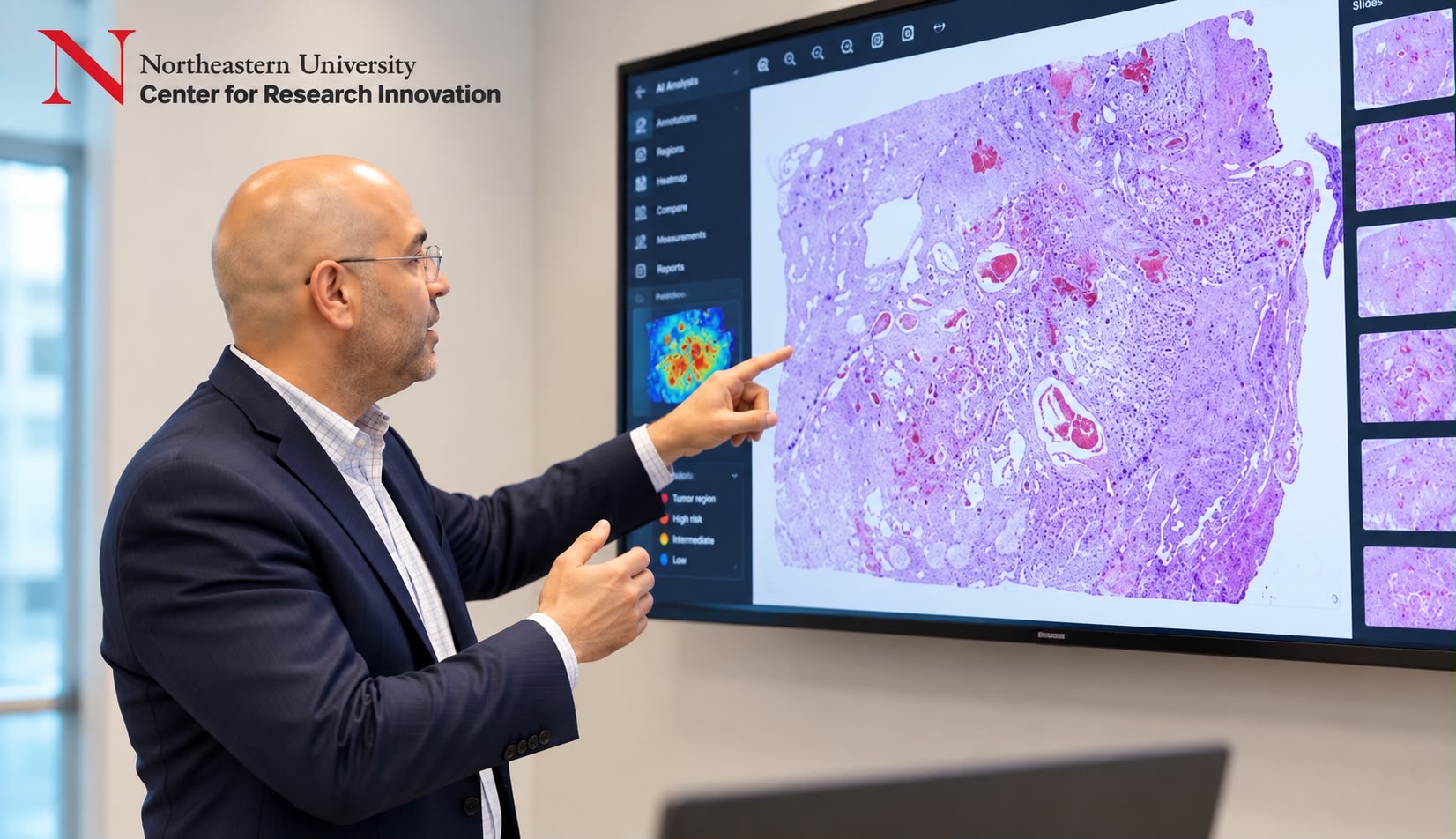
Behind every pathology slide is a patient waiting for an answer. That idea drives Santovia Path AI, a Northeastern University spinout building artificial intelligence to help pathologists review biopsy samples more quickly and consistently.
Santovia Path AI was introduced publicly in October 2026. It grew out of research in the Amal Lab for Precision Medicine at Northeastern, and in less than two years since its founding, the company has already formed partnerships with major names in digital pathology.
Solving A Growing Challenge in Pathology
When a doctor takes a biopsy from a patient, a pathologist examines the tissue to determine whether disease, such as cancer, is present. That finding is critical, as it shapes the patient’s next steps in diagnosis and treatment.
However, the field is under pressure, as pathologists are in short supply, the number of biopsies keeps growing, and different pathologists can read the same slide differently. Luckily, many cases turn out to be normal or benign, but each one still needs careful review. This can result in long wait times, unnecessary stress, and confusing results for patients.
From The Amal Lab for Precision Medicine to Santovia Path AI
The research behind Santovia Path AI began about five years ago in the lab of Saeed Amal, PhD, research professor of bioengineering in Northeastern’s College of Engineering and a faculty member at the Roux Institute. His lab develops AI models that analyze complex medical data to improve the diagnosis and treatment of diseases such as cancer. Over the years, the team has published research applying AI to digital pathology for prostate, breast, gastric, kidney, and colorectal cancers.
“Translational research succeeds when scientific discoveries become tools clinicians can trust and patients can benefit from. Santovia Path AI grew from that commitment in the Amal Lab for Precision Medicine,” said Prof. Amal.
About two years ago, Northeastern’s Institute for Experiential AI joined the effort, adding expertise in applied AI for health care.
The work caught the attention of Alexander Kouspakian, MBA, now CEO of Santovia Path AI. A Northeastern alumnus with more than 30 years of experience, Kouspakian also leads Bioskills of the Northeast, which focuses on surgical training. He saw potential in Northeastern’s existing patents and algorithms, along with access to novel clinical data through his network. Santovia Path AI was formed in fall 2024, with Prof. Amal as co-founder and Chief Scientific Officer.
A New Kind of Pathology Platform: How SAINT Works
The company’s platform, SAINT, analyzes digitized images of biopsy slides. It starts with colorectal samples and sorts cases into those that appear normal and those that may need a closer look. Pathologists can then prioritize the most critical cases.
The pathologist stays in charge throughout. SAINT shares its results, the pathologist agrees or disagrees, and the pathologist decides what goes into the final report. The platform is designed to work within the digital pathology and lab systems that labs already use.
In early colorectal pathology evaluation, SAINT achieved an area under the curve (AUC) of 0.947. AUC measures how well an AI model distinguishes between two categories, such as normal and abnormal slides, with 1.0 being a perfect score.
What sets SAINT apart is its longitudinal data, which shows how a patient’s health changes over time. By linking pathology findings to a patient’s medical history, treatments, and outcomes, this data could one day help SAINT move beyond screening to predict disease progression or treatment response. Kouspakian notes that this next step will require further research and validation.
SAINT is currently intended for research use only, and the company is developing an FDA regulatory pathway for clinical use.
A Key Partnership with Prima CARE
SAINT is trained on longitudinal data from the Prima CARE health care network, a southern New England medical group serving communities including Fall River, Somerset, Tiverton, and Westport. Through a multi-year research collaboration announced in 2025, Prima CARE provides digitized patient samples for Northeastern researchers developing the AI models.
Moving Quickly From Lab to Market
The team’s early progress is already turning into industry partnerships. Recently, Santovia Path AI announced a partnership with Fujifilm. The company has secured a white-label agreement with Fujifilm and is working toward integrating SAINT with Fujifilm’s Synapse Pathology platform. Santovia Path AI has also been designated a Tier 1 vendor with Philips, another leading name in digital pathology.
“I am extremely proud of how far our team has come in such a short time—bringing academic research toward a commercial product while keeping the patient and the pathologist at the heart of our work,” said Kouspakian.
Looking Ahead: From Northeastern Research to Real-World Impact
For Kouspakian, every biopsy represents a person waiting to understand what is happening with their health, and an answer that can shape what comes next for them and their family. He says the most meaningful outcome “would be knowing that our work helped someone spend less time waiting and worrying, and take the next step toward the right treatment sooner.”
Santovia Path AI’s next steps are to keep building SAINT’s triage tool and the software needed to bring it into everyday pathology work, and to validate its performance on independent datasets and in different lab settings. As it expands its data collaborations with health care organizations, the company plans to extend SAINT to more parts of the body, including the upper gastrointestinal tract, liver, and kidney.
“The process of moving from lab to industry has shown me what is possible when researchers, clinicians, and industry partners work toward the same purpose: supporting the pathologist and getting meaningful answers to the patient,” said Kouspakian.
Santovia Path AI is part of Northeastern’s growing pipeline of health technology spinouts. Prof. Amal has credited CRI with supporting his translational research strategy, connecting him with industry and clinical partners, and helping with intellectual property filing and commercialization.
To learn more about Santovia Path AI, visit santoviapath.ai. To explore how CRI advances Northeastern research into real-world applications, visit cri.northeastern.edu.